WHERE WE STAND
The League of Women Voters of Vermont (LWVVT) is a multi-issue, non-partisan organization, highly respected for its activism, particularly in the areas of voting rights, election integrity, civil rights, and ethics.
While there are many important and challenging issues where the League can have an impact, we can only take action when we have an official position.
What is a Position?
A position is a statement representing the League’s point of view on key public policy and legislative issues. It is the cornerstone of League advocacy, used primarily to support or oppose legislation. Positions are arrived at through study and member consensus or by concurrence with other leagues. The process used in formulating positions sets the League apart from other organizations, making our advocacy trustworthy and respected.
If the League does not have a position on a particular topic, members can initiate a study of the issue or defer to national positions. As a part of LWV United States, LWVVT automatically has use of all positions within the national league’s Impact on the Issues publication.
League of Women Voters of Vermont Positions
Studies
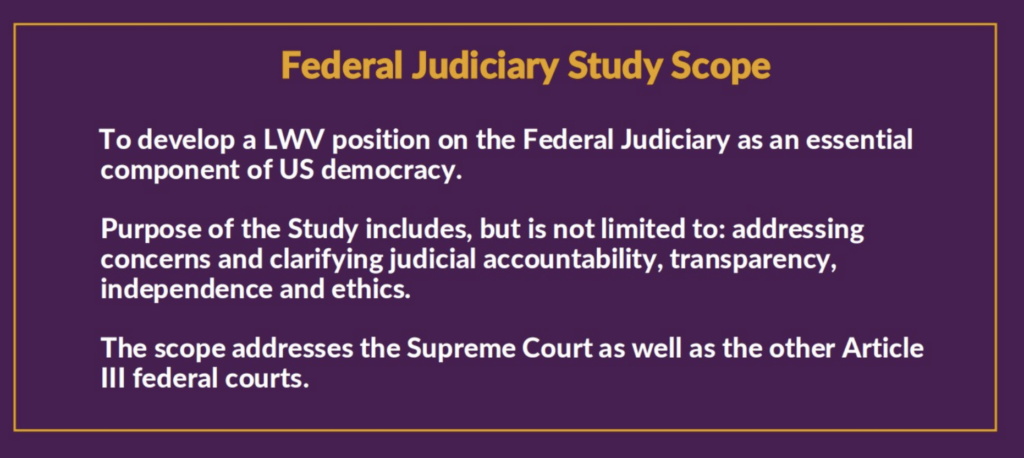
Members play a vital role in identifying and proposing public policy issues that guide League activity. Studies, which are the basis of positions, are based on strong grassroots member involvement, which makes League action uniquely credible and valued.
Image Left: At the LWVUS convention in 2024, delegates approved a national study of the federal judiciary as a step towards adopting a position.
Members may initiate a study of an issue when the League does not have a position on a particular topic.
- Members vote on an issue to be studied. A Study Committee examines the issue in a non-partisan, unbiased, and objective manner to determine the means by which the study will be adopted, either by consensus or concurrence.
- A consensus study involves gathering information through research that includes reviewing all sides of the issue, pros and cons, interviewing experts, elected and public officials, and compiling a bibliography. It concludes with writing reports, hosting educational sessions, and member discussion. A study usually takes two years.
Consensus by group discussion is the most common technique used to reach member agreement. It is based on the overall sense of the group, not on simple majority or unanimity. When members reach consensus, a position statement is written to be approved by the Board of Directors and accepted by members at the State Convention.
- Occasionally, members use the concurrence approach where the League formally agrees with a position already arrived at by another League. In place of conducting a new study, members vote to adopt the position of another league by concurrence. This allows for prompt and timely action on any proposed or pending legislation and bypasses the lengthy study process.
- Once the board has finalized a position, action can be taken through various means: lobbying elected officials, testimony, letter-writing campaigns, informing the public, and litigation, among others.
League studies from across the nation can be found in the League of Women Voters Education Fund Clearinghouse for Studies.
Program & Issues
Members use the word Program to refer to the issues they choose for study, education, and action. Each member can influence the selection of issues where the League will focus time, talent, and resources.
Members engage in program planning every two years and present results to the Board of Directors. The Board reviews program suggestions and recommends some or all of them for approval at the biennial convention for the upcoming two-year period.
Impact on Issues 2026-2028
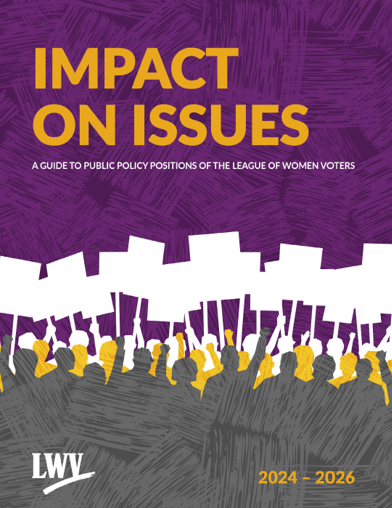
Impact on Issues, the 2024-2026 edition of the guide listing the League of Women Voters of the United States (LWVUS) public policy positions, is an indispensable resource designed to help state and local leagues strengthen our impact at all levels of government.
The League of Women Voters of Vermont can use both the Principles (broad statements of beliefs) and Positions (specific statements and guidelines) to develop support for actions in our communities.
Impact on Issues is updated biennially.
2025-2027 Program
Affirmed by the 59th State Convention delegates on June 7, 2025
The League of Women Voters of Vermont adopted the LWVUS program Campaign for Making Democracy Work, to continue work on the following issues:
- Voting Rights
- Improving Elections
- Money in Politics
- Redistricting
The Campaign for Making Democracy Work seeks to ensure a free, fair, and accessible electoral system for all eligible voters. The League continues to protect and advance voting rights and election reform during this critical time for our democracy.
Principles and Issues
The League of Women Voters believes all powers of our government should be exercised within the constitutional framework of balance among the three branches of government: legislative, executive, and judicial. We believe in representative government and in the individual liberties established in the Constitution of the United States.
Throughout the years, the League has continued its dual purposes of education and advocacy by engaging in studies on representative government, social policy, natural resources, and international relations. A short summary of these major themes is listed below.
Representative Government. Every citizen should be protected in the right to vote and the government should be responsive and accountable to the will of the people.
Voting Rights
Redistricting
Selection of the President (Electoral College)
Election Security
Citizen Rights
Money in Politics
Voter Education
Ranked Choice Voting
Privatization
Social Policy. Secure equal rights and equal opportunity for all through social and economic justice and the health and safety of all Americans.
Education
Health Care
Human Trafficking
Meeting Basic Human Needs
Equal Rights
Reproductive Health
Gun Policy
Ethics
Immigration
Transportation
Housing
Child Care
Public Banking
Natural Resources. Promote the conservation and wise management of natural resources in the public interest.
Air Quality
Climate Change
Energy
Waste Management
Land Use
Water
International Relations. Peace in an interdependent world calls for working cooperatively with other nations and developing international law.
United Nations
Trade